
WiFi 7 Compared with WiFi 6: Bandwidth, Modulation, and Link Improvements
WiFi 7, also called 802.11be, targets higher throughput and lower latency than WiFi 6 through changes to the PHY and MAC layers. Its advances include 320 MHz channels, 4096-QAM, more spatial streams, flexible resource allocation, and Multi-Link Operation.
Understanding WiFi 7
Following WiFi 6/6E, WiFi 7 is the next-generation wireless standard. Also known as 802.11be, it targets Extremely High Throughput (EHT) through changes to both the physical (PHY) and MAC layers.
Its PHY improvements include 320 MHz bandwidth, 4K-QAM, Multi-RU, and enhanced MU-MIMO. At the MAC layer, Multi-Link Operation (MLO) enables link aggregation. Together, these technologies increase throughput and reduce latency compared with WiFi 6.
How WiFi Has Evolved
The original 802.11 protocol, released in 1997, supported speeds of up to 2 Mbps. The later, popular 802.11ax standard raised that ceiling to 9.6 Gbps.
|
Protocol |
WiFi |
Time |
Speed |
|
802.11 |
/ |
1997 |
Up to 2 Mbps |
|
802.11a/b/g |
WiFi |
1999-2003 |
Up to 54 Mbps |
|
802.11n |
WiFi 4 |
2009 |
Up to 600 Mbps |
|
802.11ac |
WiFi 5 |
2013 |
Up to 6.9 Gbps |
|
802.11ax |
WiFi 6/6E |
2019-2021 |
Up to 9.6 Gbps |
|
802.11be |
WiFi 7 |
2024 |
Up to 46 Gbps |
Comparing WiFi 7 and WiFi 6
|
Technology |
WiFi 6 |
WiFi 7 |
|
Standard |
IEEE 802.11ax |
IEEE 802.11be |
|
Max theoretical data rate |
~9.6Gbps |
~46.1Gbps |
|
Frequency band |
2.4 GHz, 5 GHz, 6 GHz (WiFi 6E) |
2.4 GHz, 5 GHz, 6 GHz |
|
Channel bandwidth |
20 MHz, 40 MHz, 80 MHz 80+80 MHz, 160 MHz |
Up to 320 MHz |
|
Highest modulation order |
OFDMA |
OFDMA |
|
Max number of spatial streams |
8×8 UL/DL MU-MIMO |
16×16 UL/DL MU-MIMO |
|
Security |
WPA3 |
WPA3 |
WiFi 7 revises nearly every aspect of the standard, with WLAN throughput almost 5× faster than WiFi 6. The main changes span both PHY and MAC operation.
Bandwidth up to 320 MHz
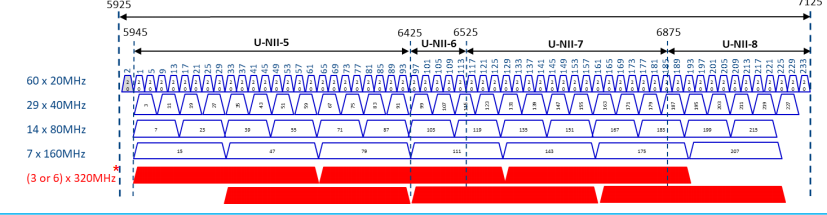
Opening the 6 GHz band provides wider, cleaner spectrum for WiFi. WiFi 7 introduces a 320 MHz bandwidth mode in that band, doubling throughput relative to WiFi 6’s 160 MHz. It also accommodates non-contiguous bandwidth combinations, including 160+80 MHz and 160+160 MHz.
4K-QAM Modulation
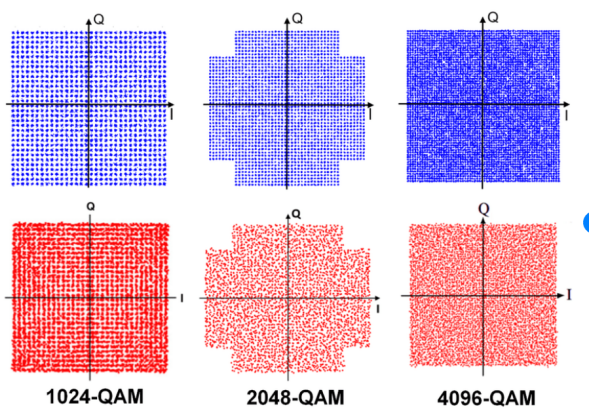
Moving from WiFi 6’s 1024-QAM to 4096-QAM allows each modulation symbol to carry 12 bits. With identical coding, this higher modulation order delivers a 20% rate increase over 1024-QAM.
Additional Spatial Streams and Enhanced MU-MIMO
The maximum number of spatial streams rises from 8 to 16, doubling the theoretical physical transmission rate.
Multi-RU and Preamble Puncturing
WiFi 6 restricts a user to a single resource unit (RU), without assigning a different RU. WiFi 7 permits multiple RUs to be allocated to nodes, making resource use more flexible and efficient.
Multi-RU uses puncturing of the operating channel: occupied portions can be masked while available channels remain in use. This improves channel utilization and avoids transmission on frequencies not authorized by local regulations.
Multi-Link Operation (MLO)
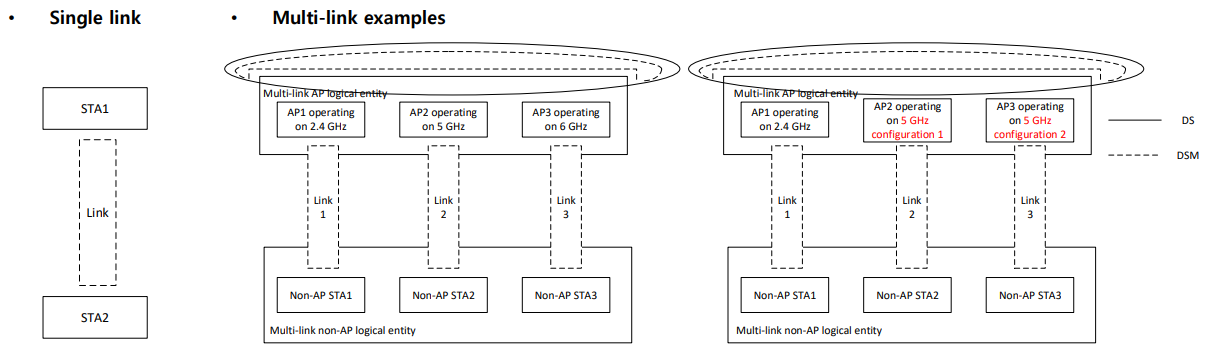
MLO aggregates links at the MAC layer, mapping a link to a channel and band. It can increase throughput and reliability while lowering latency, benefiting applications ranging from VR/AR to industrial IoT.
Multi-AP Coordination
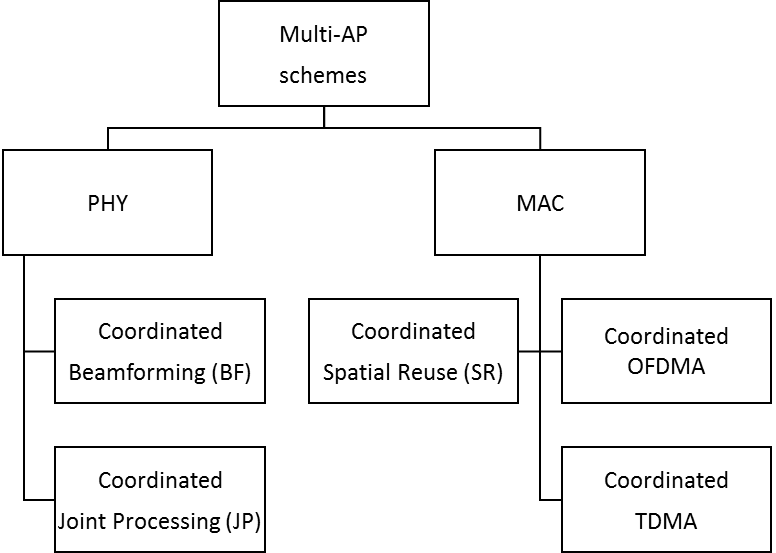
Multi-AP encompasses features that coordinate access points directly to meet network performance goals. Several approaches are being considered, including coordinated OFDMA (C-OFDMA), coordinated spatial reuse (CSR), coordinated beamforming (CBF), and joint transmission (JXT), for application at the MAC or PHY layer.
Handpicked News
Adjust TP-Link Deco Wi-Fi Channels and Channel Width in the App
Wi-Fi 8 and Wi-Fi 7 Compared: Reliability, Speed, and Upgrade Timing

WiFi 6 and WiFi 6E: What the 6 GHz Extension Changes
Wi-Fi 5 or Wi-Fi 6: Understanding the Upgrade—and Where Wi-Fi 7 Fits
Choosing a Wi-Fi Band in Windows 11 and Windows 10
Stay ahead of the story
Get one weekly email with the best of RouterSetup Desk.

